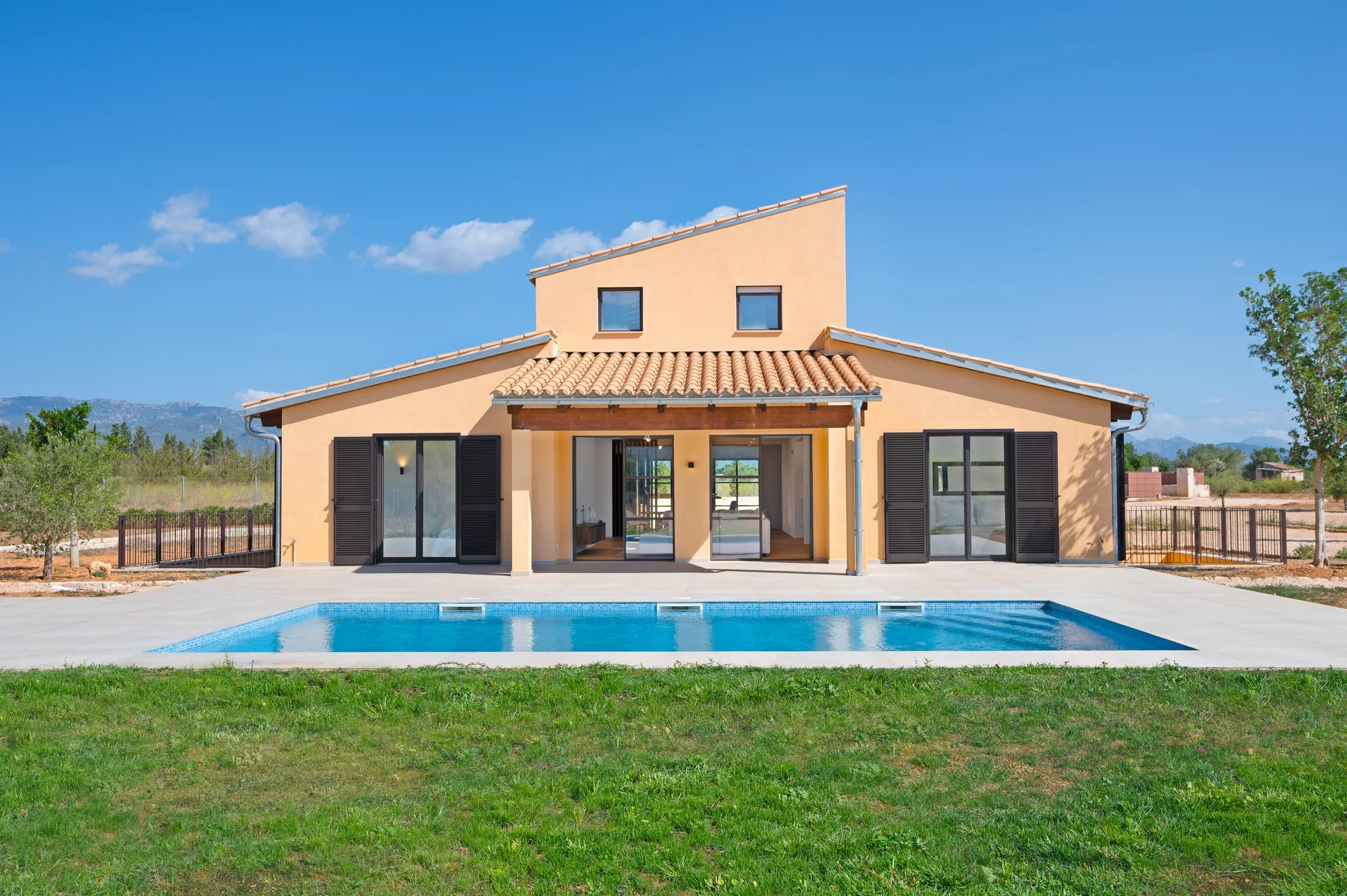

Costs of buying property in Mallorca: taxes and fees explained
By far the largest of the costs of buying property in Mallorca is the tax on the purchase itself. Which tax applies depends on whether you buy a resale property or a new build directly from the developer. On top of that come notary and land registry fees, a few formalities before signing and, once you own the property, annual taxes. This guide sets out the rules in force in September 2026 and gives the legal basis for every figure.
Transfer tax (ITP) on resale property
If you buy an existing villa or finca in Mallorca, you pay the Balearic transfer tax, the Impuesto sobre Transmisiones Patrimoniales (ITP). It is charged on a sliding scale according to the value of the property:
| Value of the property | Rate on that portion |
|---|---|
| up to €400,000 | 8 % |
| €400,000.01 to €600,000 | 9 % |
| €600,000.01 to €1,000,000 | 10 % |
| €1,000,000.01 to €2,000,000 | 12 % |
| over €2,000,000 | 13 % |
These bands have applied since 1 January 2024, and the consolidated text of the law as amended on 13 June 2026 still contains them unchanged. The scale produces an average rate, rounded to two decimal places, which is then applied to the full value.
The taxable base is the cadastral reference value (valor de referencia) on the day of purchase. If the agreed price or the declared value is higher, the higher figure is used. The tax is declared and paid to the Balearic tax agency (ATIB) on form 600 within one month of the date of the deed.
The Balearic reduced rates and exemptions only apply to a buyer's main home up to a value cap far below prices in the luxury segment. For villas and fincas above two million euros, they do not come into play.
New builds from a developer: VAT and stamp duty instead of ITP
If you buy a home as the first delivery from the developer, you pay VAT, the Impuesto sobre el Valor Añadido (IVA), instead of ITP. For residential buildings the rate is 10 %, which also covers up to two parking spaces and annexes sold together with the home.
The notarial deed is also subject to stamp duty, the Impuesto sobre Actos Jurídicos Documentados (AJD). The general Balearic rate is 1.5 %. Where the property is worth €1,000,000 or more, a higher rate of 2 % applies, and it applies to the whole value. For most new-build villas in Mallorca, the 2 % rate is therefore the relevant one. AJD must also be paid within one month.
If a new build is sold on by a later owner rather than by the developer, that is normally no longer a first delivery, and ITP applies again.
Worked examples
The figures below are worked examples using the rates above. They assume the price is not below the cadastral reference value and exclude notary, registry and advisory fees.
| Purchase price | Resale: ITP | New build: 10 % VAT + 2 % AJD |
|---|---|---|
| €2,000,000 | €210,000 (10.50 %) | €240,000 |
| €3,000,000 | €339,900 (11.33 %) | €360,000 |
| €5,000,000 | €600,000 (12.00 %) | €600,000 |
| €10,000,000 | €1,250,000 (12.50 %) | €1,200,000 |
For ITP, the amount follows from the scale and the rounded average rate; for new builds, from 10 % VAT and 2 % AJD.
Notary and land registry
Notary and land registry fees in Spain are set by the state and depend on value. Notaries charge on a decreasing scale: between €601,012.10 and €6,010,121.04 the rate is 0.3 per thousand on the amount in that band. For any value above €6,010,121.04, the notary agrees the fee freely with the parties. A 5 % discount applies to the amount under the scale. Copies and the number of pages of the deed are charged in addition.
The land registry (Registro de la Propiedad) also charges on a scale; above €601,012.10 the rate is 0.20 per thousand, again with a 5 % discount. Compared with the purchase tax, both items are small.
The NIE: your Spanish tax number
You cannot buy property in Spain without a Spanish tax number: in every deed transferring rights over real estate, the notary must record the tax numbers of the parties. For foreign nationals this is the NIE (Número de Identidad de Extranjero). It is issued to foreigners with economic, professional or social ties to Spain.
The application is made on form EX-15: in Spain in person at an immigration office or police station, or from abroad through a Spanish consulate. A fee is paid using form 790, code 012. The authorities must decide within five days of receiving the application. Even so, it is worth organising the NIE early, as appointments at offices and consulates are not always available at short notice.
Paying the purchase price
In the deed, the notary records how the price was paid: whether before or at signing, how much, and by what means, for example bank transfer or banker's draft. Keep evidence of every payment to hand, including any deposit paid under the private preliminary contract.
Buying from a seller who is not resident in Spain
If the seller is not resident in Spain, the buyer must withhold 3 % of the agreed price and pay it to the Spanish tax agency as a payment on account of the seller's tax. This is done on form 211 within one month of the transfer. If the amount is not paid over, the property itself stands as security for that amount or the seller's lower tax liability.
The municipal land value tax (plusvalía municipal) also concerns the buyer. It is the seller's tax, but where the seller is an individual not resident in Spain, the buyer becomes liable in the seller's place. Plusvalía only applies to urban land; land classed as rural (rústico) for property tax purposes is outside its scope, so it may not arise on a finca in the countryside.
Annual taxes after the purchase
- Property tax (IBI): each municipality sets its own rate on the cadastral value, between 0.4 % and 1.10 % for urban property and between 0.3 % and 0.90 % for rural property, with possible surcharges.
- Non-resident income tax (IRNR) on personal use: non-residents who use an urban property themselves or leave it empty are taxed on deemed income of 1.1 % or 2 % of the cadastral value, depending on when the municipality last revised its cadastral values. The rate is 19 % for residents of the EU, Iceland, Norway and Liechtenstein, such as buyers from Germany or Austria, and 24 % for everyone else, including residents of Switzerland and the United Kingdom. No expenses can be deducted; the return is filed on form 210.
- Wealth tax: non-residents are liable on their assets located in Spain, assessed on 31 December, with a tax-free allowance of €700,000. Anyone who becomes resident in the Balearic Islands falls under the Balearic rules: an allowance of €3,000,000 and rates from 0.28 % to 3.45 %.
Questions and answers
How much is property transfer tax in Mallorca?
On resale property, between 8 % and 13 % on a sliding scale by value, with 13 % on the portion above €2,000,000. On a price of €3,000,000 this works out at an average rate of 11.33 %.
Do I pay transfer tax on a new build?
No. When you buy from the developer, you pay 10 % VAT instead of ITP, plus AJD stamp duty, at 2 % where the value is €1,000,000 or more.
Do I need an NIE to buy property in Mallorca?
Yes. The notary has to record the tax numbers of everyone involved in the deed, and for foreign nationals that number is the NIE. You can also apply from abroad through a Spanish consulate.
Who pays plusvalía when buying property in Spain?
In principle the seller. If the seller is an individual who is not resident in Spain, the buyer owes the tax in the seller's place. This should be dealt with in the purchase contract.
What is the 3 % retention when buying from a non-resident?
If you buy from a seller who is not resident in Spain, you withhold 3 % of the price and pay it to the tax agency on form 211. It is a payment on account of the seller's tax and comes out of the purchase price; it is not an additional tax for you.
Which taxes do I pay each year if I do not live in Mallorca?
The municipal property tax IBI, non-resident income tax on deemed income from personal use and, above the €700,000 allowance, wealth tax.
Finding the right property with Unisono
Unisono Luxury Homes is an estate agency in Mallorca. For tax and legal questions about your purchase, please consult a tax adviser or lawyer of your choice; we help you find and view the properties. You will find our current listings under property for sale in Mallorca and villas for sale in Mallorca. To ask about a specific property, please use our contact form.
The information on this page does not replace tax or legal advice. Information correct as of 21 September 2026.